

Key Concepts
Key Concept #1: Trauma and chronic stress can adversely impact our behavior, relationships, and ability to function in school and at work.
Our brains are beautifully built to adapt to challenges by shifting the body’s energy and focus. Stress is a natural human response that prompts us to meet the demands and challenges in our lives. Not all stress is bad for us (see the CA Surgeon General’s Report).
Positive stress is characterized by brief elevations in stress hormones (e.g., prepping for a big game or test) and is a necessary and essential part of growth and development; it can help us to mobilize energy and increase focus for the task at hand.
Tolerable stress activates the body’s alert system to a greater degree (e.g., loss of a loved one, a frightening injury), but is time-limited and buffered by supportive relationships which helps to facilitate recovery.
Toxic stress results from prolonged or chronic activation of the stress response systems without buffering support and can have lasting effects on the brain, body, and behavior.
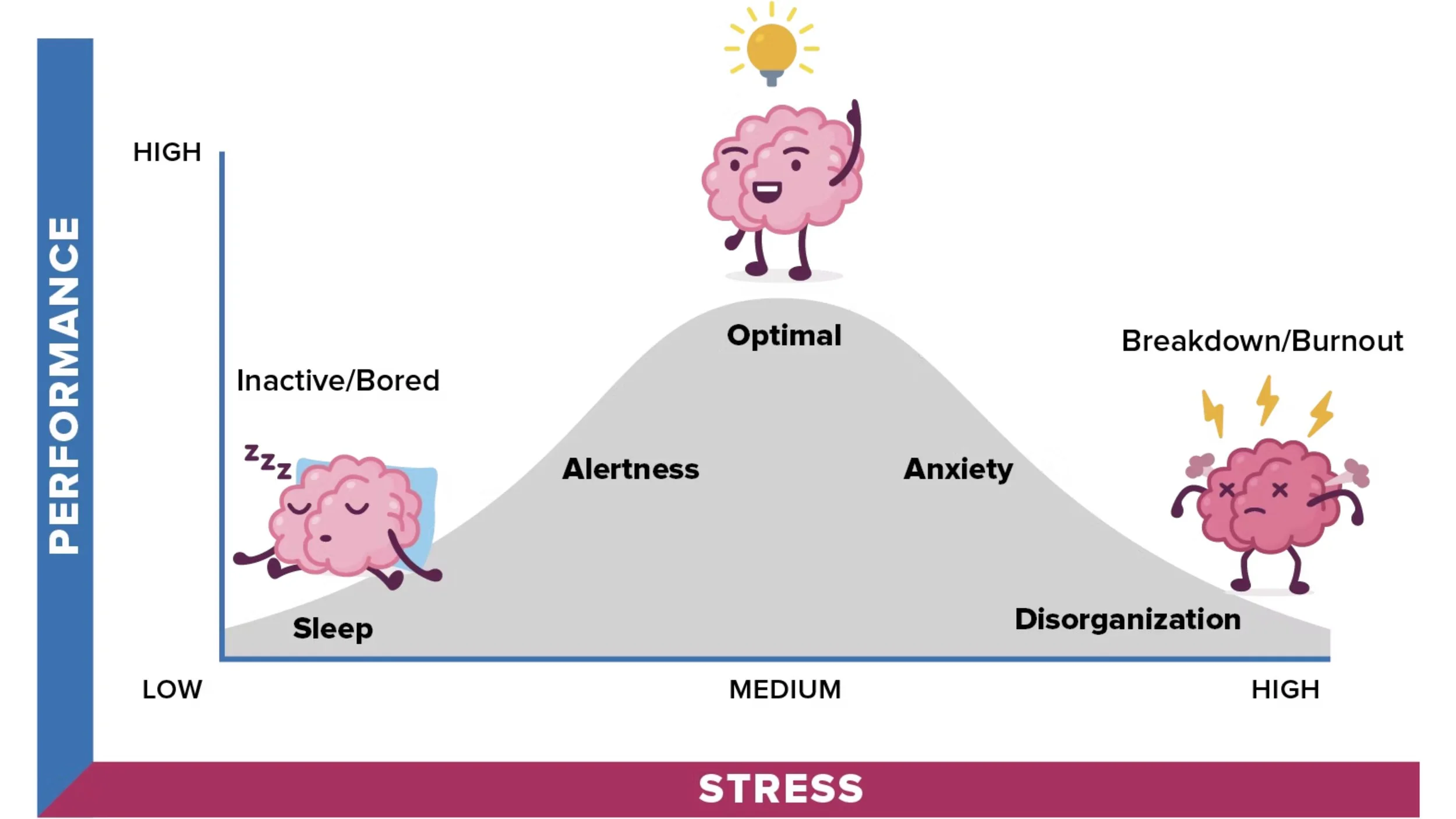
Stress affects staff job performance. The Yerkes-Dodson Law shows how stress affects our job performance.
If we have too little stress arousal, we may not have the energy and alertness that we need to perform at our best.
An optimal level of stress arousal is good for the most efficient and effective job performance.
If our stress arousal is too high, we become overwhelmed and lose access to the skills and knowledge that we normally have, and our job performance plummets.
Figure 1.1. Yerkes-Dodson Law
Stress also affects student health, development, and educational attainment. Learning how to cope with adversity is an important part of healthy child development.
When a young child’s stress response systems are activated within an environment of supportive adult relationships, the physiological effects of stress are buffered and brought back down to baseline. The result is the development of healthy stress response systems.
However, a stress response that is extreme and long-lasting, without the buffering support of nurturing relationships, can disrupt a child’s brain development and other regulatory systems (see Harvard’s Center for the Developing Child).
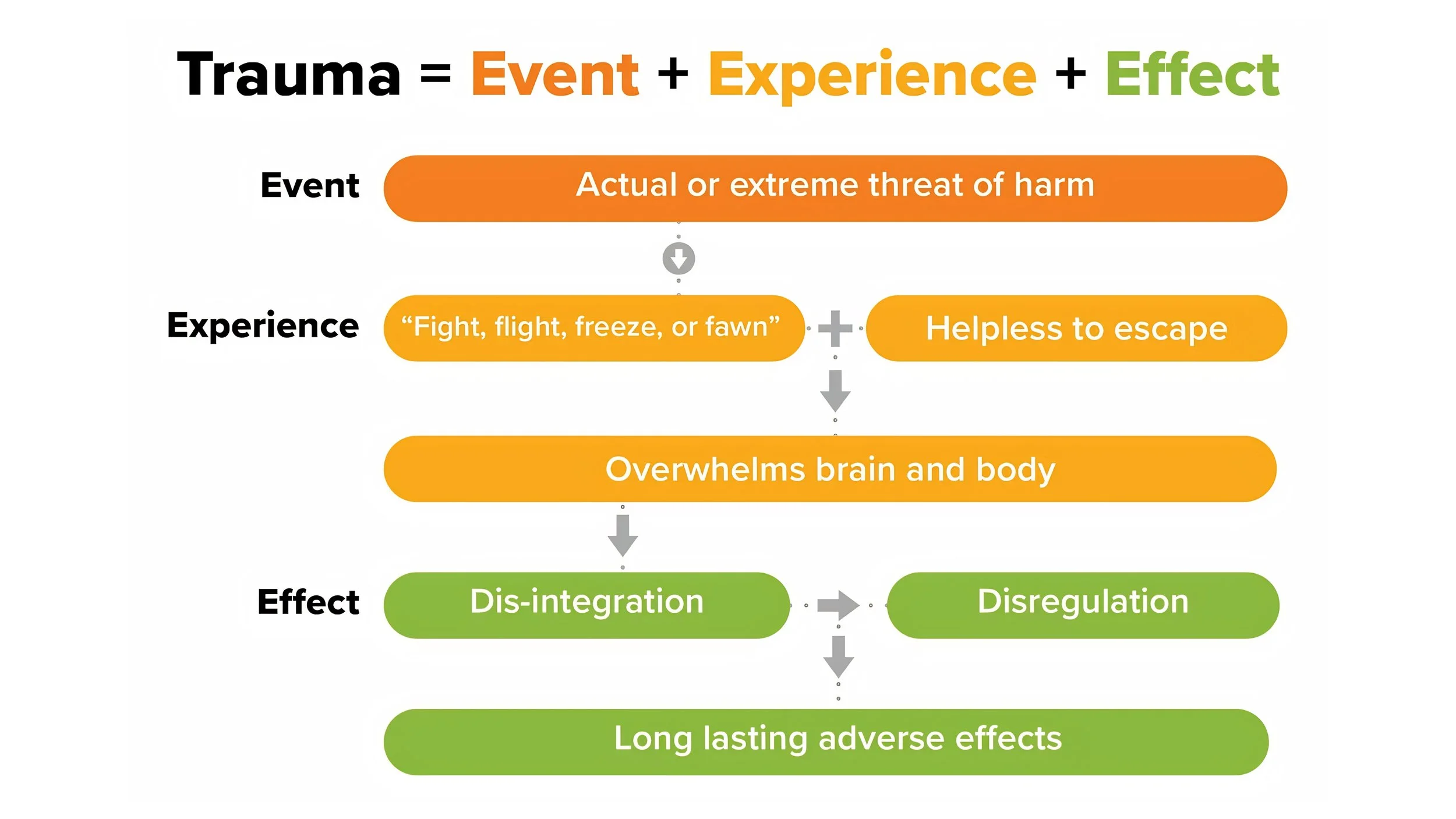
Trauma = Event + Experience + Effect. Trauma results from “an event, series of events, or set of circumstances that is experienced by an individual as physically or emotionally harmful or life-threatening and that has lasting adverse effects on the individual’s functioning and mental, physical, social, emotional, or spiritual well-being." 1-5
EVENT: A potentially traumatic event presents an actual danger or extreme threat of harm which can be experienced directly or indirectly.
EXPERIENCE: When we are under threat, our brains and bodies mobilize into a survival response of “fight, flight, freeze, or fawn.” What makes a circumstance traumatic is that despite our efforts, we are helpless to escape the inundating stressor. This overwhelms our brain and body’s ability to cope.
EFFECT: This leads to a dis-integration of the parts of our brain and body that normally work well together. This in turn results in dysregulation, which is a loss of capacity to modulate internal stress arousal and emotional states. This can have lasting adverse effects.
Figure 1.2. 3 E's of Trauma
Key Concept #2: We can overcome, heal from, and be resilient in the face of trauma.
People impacted by trauma may have injuries, but are not “sick” or “bad.” It is possible to heal from trauma given the right conditions: a healing-centered work, school, or care environment, as well as caring and reliable others (e.g., loved ones and/or professionals).
Trauma may be part of our story, but none of us need to be defined by the worst things that have happened to us. When given the opportunity to heal, we can come out of the healing process stronger, wiser, more compassionate, and even uniquely qualified to give back to the world.
Key Concept #3: Neurons that fire together wire together.
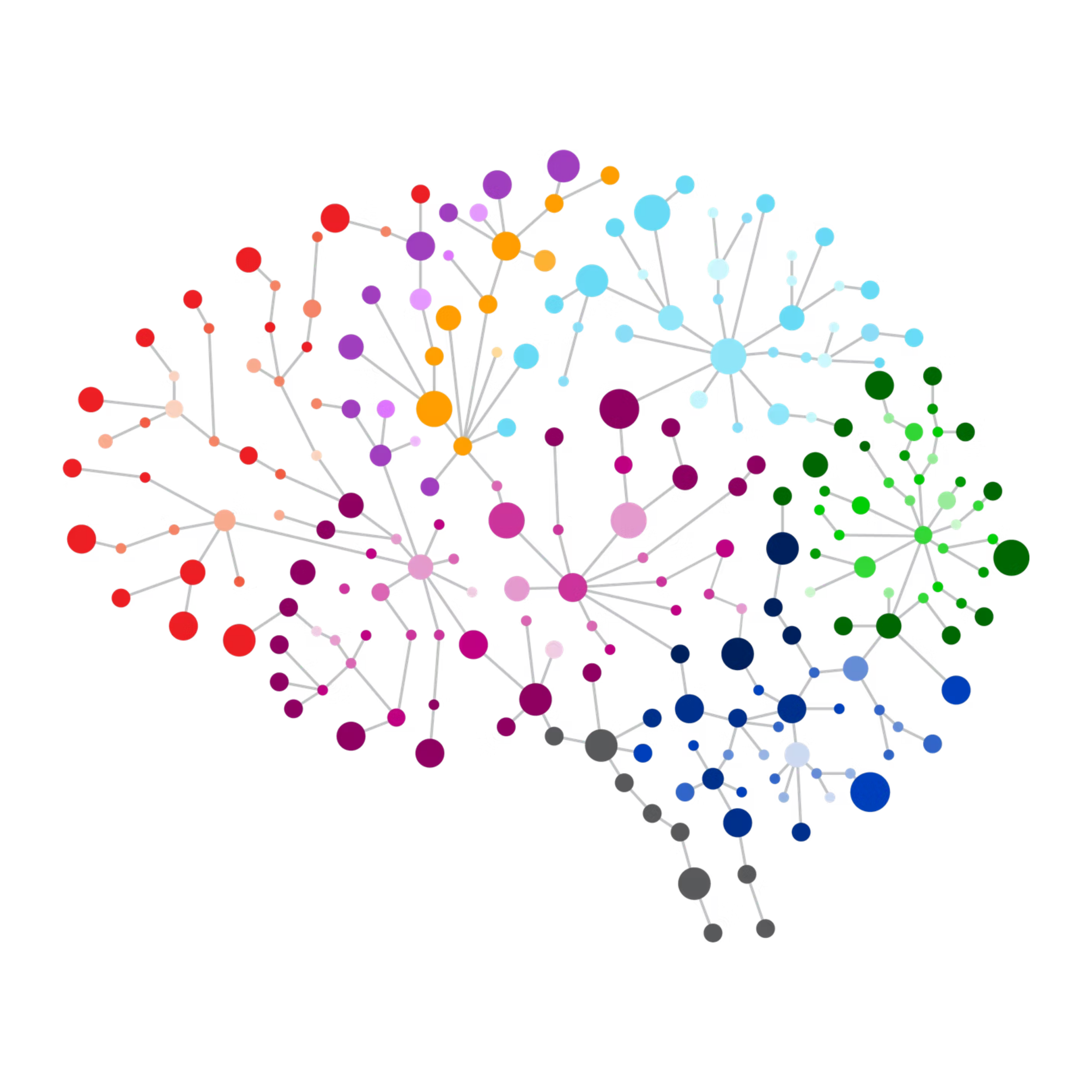
Our brain and the rest of our nervous system are made up of neural networks. Whenever we do, think, or feel anything, networks of neurons fire together.
Every time neurons fire together, they wire together more strongly (Hebb’s rule). As a result, the more we repeat actions, thoughts, or feelings, the stronger those neural connections become. Put simplistically, repeating a neural response over and over wears a pathway (or “groove”) in our brain that we can more quickly and easily get into, which makes these responses more automatic. This is why “practice makes perfect,” and it is how we form habits.
Trauma wears a groove in the brain. When “fight, flight, freeze, or fawn” is what is firing over and over again in our neural pathways, this response is what gets wired up strongly into a habitual response. When someone has experienced a repeated threat and they are in a chronic state of fear, this creates a strong automatic pathway,6 much like a groove in a record or a rut in a road, such that they are much more easily knocked into a fear response by triggers (reminders of the traumatic event), even when they are not actually in danger.
The brain can rewire towards health in childhood and throughout our lifespans. Patterned, repetitive stimulus to the brain (e.g. through repeating healthy behaviors and positive interactions) can rewire the brain towards health.7
Key Concept #4: Trauma can interfere with our ability to access our thinking-learning brains.
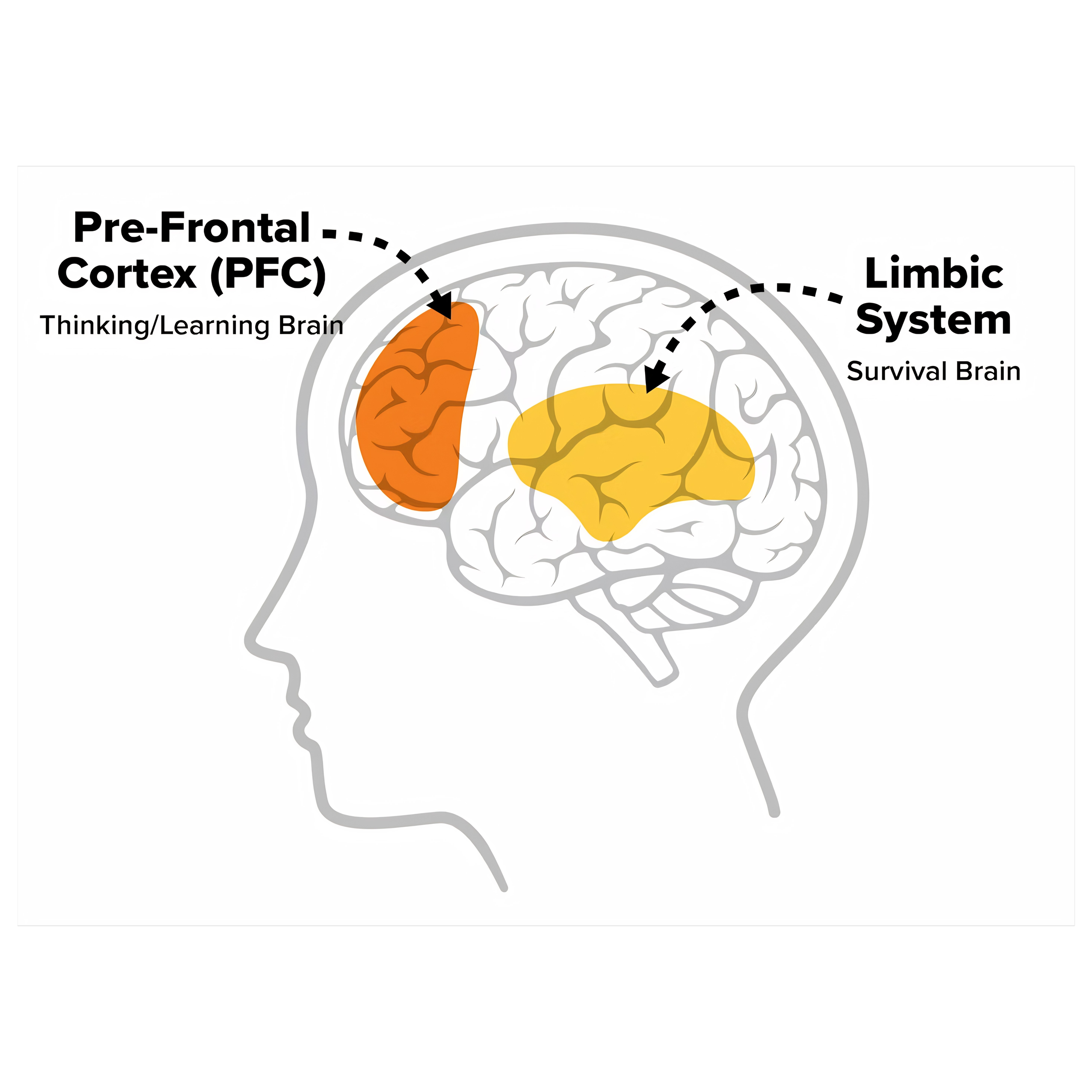
The prefrontal cortex (thinking-learning brain), located just behind the forehead, is important for higher-level executive functions (e.g., paying attention, rational thinking).
The limbic system (survival-emotional brain), located in the mid-brain, is associated with strong emotions and survival (e.g., fight/flight/freeze).
When triggered, the thinking-learning brain goes offline, and the survival brain takes over. The body and brain behave like a past trauma is happening right now.
Self-regulation occurs when the thinking-learning brain and the survival-emotional brain are integrated and working well together.
While self-regulation can manifest as being calm, individuals can also be experiencing strong emotions and still be self-regulated.
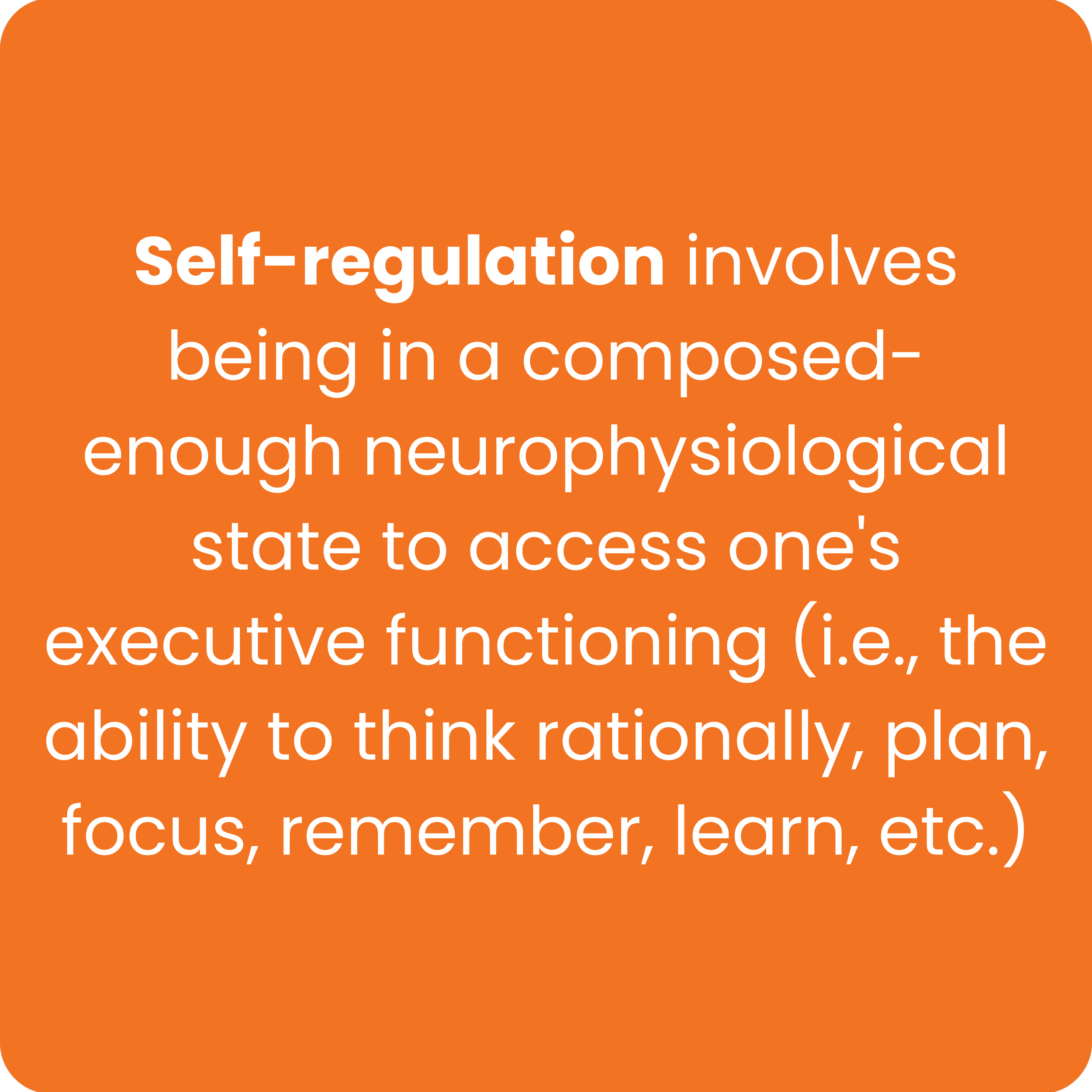
Figure 1.3. Brain Regions Involved in Trauma Response
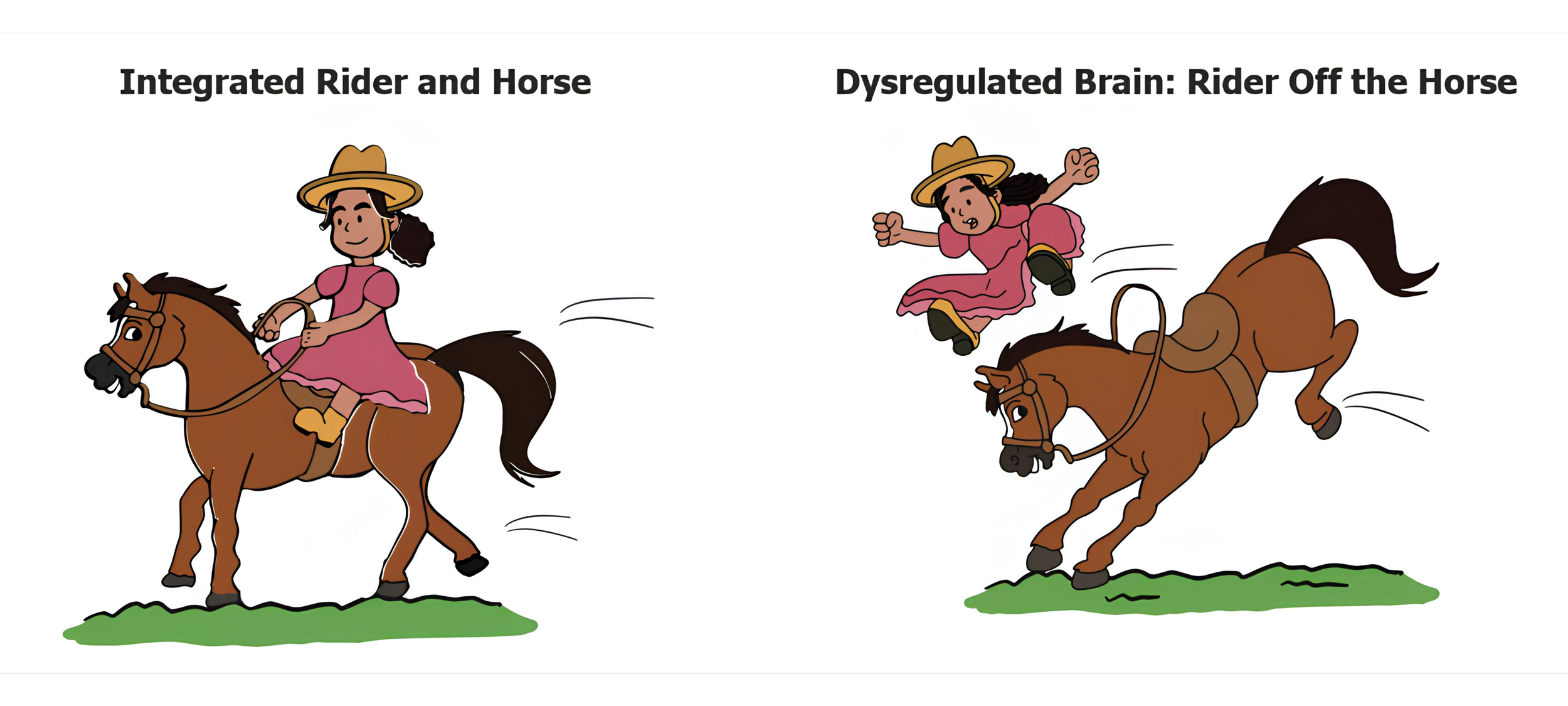
Rider and horse metaphor. The thinking-learning brain can be thought of as a rider on a horse that sits up high and makes informed, rational decisions. The survival brain is the horse that is lower down, very strong, and acts on protective instincts and feelings.
When the rider and horse are integrated and working together, they can go far and do productive work.
But when triggered, the rider falls off the horse, and the survival brain takes over, which leads to dysregulation (i.e. the loss of ability to self-regulate).
When the rider is off the horse, any intervention that requires rational thinking or any reaction that increases a sense of threat can escalate the situation further. The more power we have in a relationship or organization, the more our own rider-off-the-horse behavior can cause harm to others.
Figure 1.4. Rider and Horse Metaphor
Key Concept #5: Not only can trauma derail the functioning of individual brains, it can also adversely affect organizational systems.
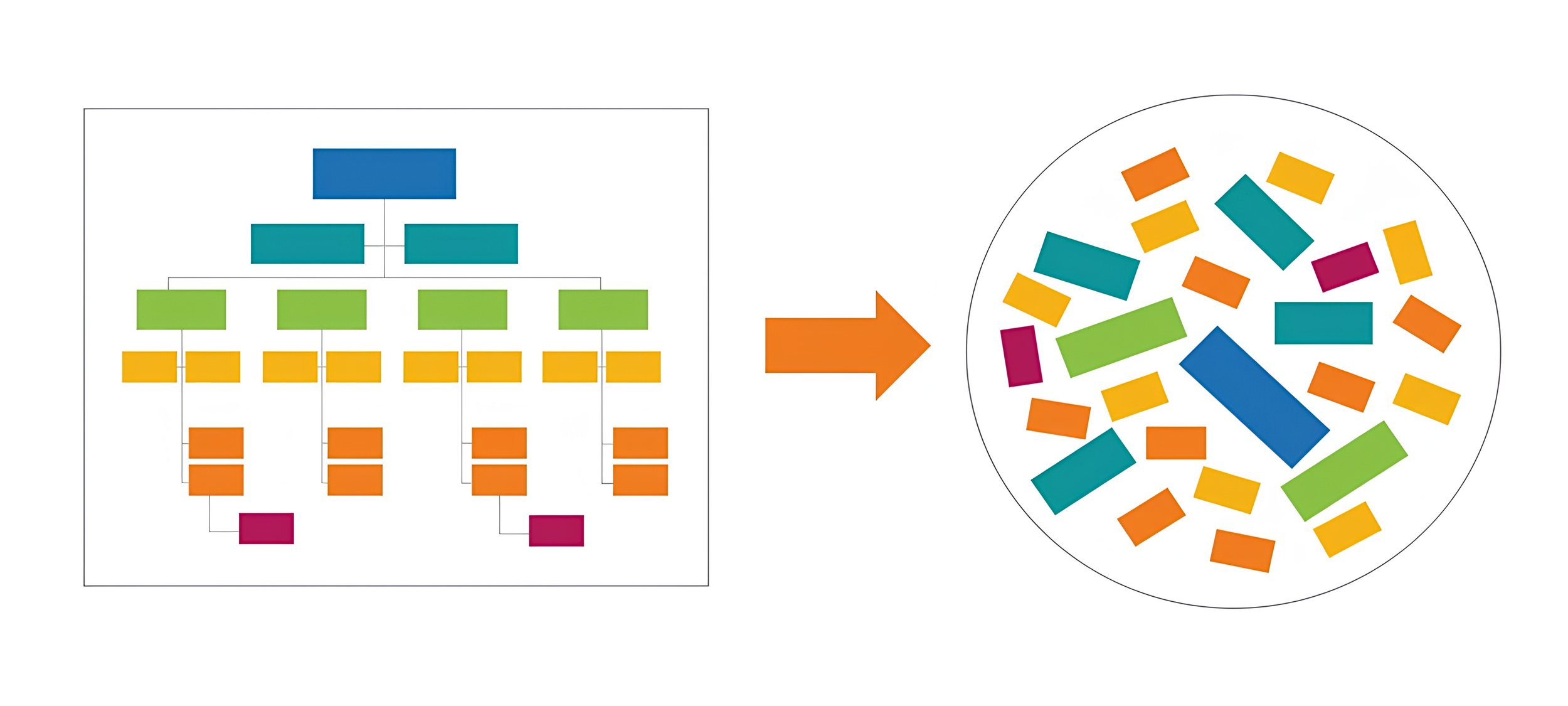
Trauma fragments. It can fragment individuals’ brain functioning, fragment relationships, and fragment organizations.
When organizations are over-stressed and under-resourced, they can become dis-integrated and disorganized.
Organizational “symptoms” might look like a lack of cohesiveness between or among teams, silos, scapegoating, blaming, hypervigilance, big reactions to small things, fear-driven decision-making, overwhelm, crisis-driven, repeated re-telling of horror stories, numbing, avoidance, helplessness, over-focus on threat reduction, and control and order at the expense of innovation and relationships
Figure 1.5. Trauma Fragments Organizations
Key Concept #6: A trauma-informed, healing-centered organization is integrated, reflective, relationship-centered, prevention-oriented, adaptable, and fosters equity, inclusion, and belonging for all.
The journey to become a trauma-informed, healing-centered organization involves a transformation from being trauma-inducing to being trauma-reducing.
Attending to our own self-regulation and wellness as adults through self-awareness, self-management, help from caring others, and organizational support is critical to the well-being of self and others.
We as adults in schools need to learn how to keep our riders on our horses, to get our riders back on our horses if they fall off, and/or how to ask for help when we need it in the moment so that we do not cause harm to students and/or one another. Further, promoting wellness must be done on an organizational level, sometimes known as “collective care”10 (e.g. through time and space to connect with one another and manage stress collectively), rather than simply relying on self-care practices.
This work is licensed under a Creative Commons Attribution-NonCommercial-ShareAlike 4.0 International License.