

HEARTS Professional Learning Toolkit
This toolkit is designed to support school teams on their journey towards becoming a trauma-informed school. For each of the six guiding HEARTS principles, the toolkit describes:

Key Concepts

Individual and Relational Staff Practices

Systems Level Policies, Routines, and Procedures

Reflection Questions

Additional Resources
Click on the principles listed below to access resources, tools, and more!
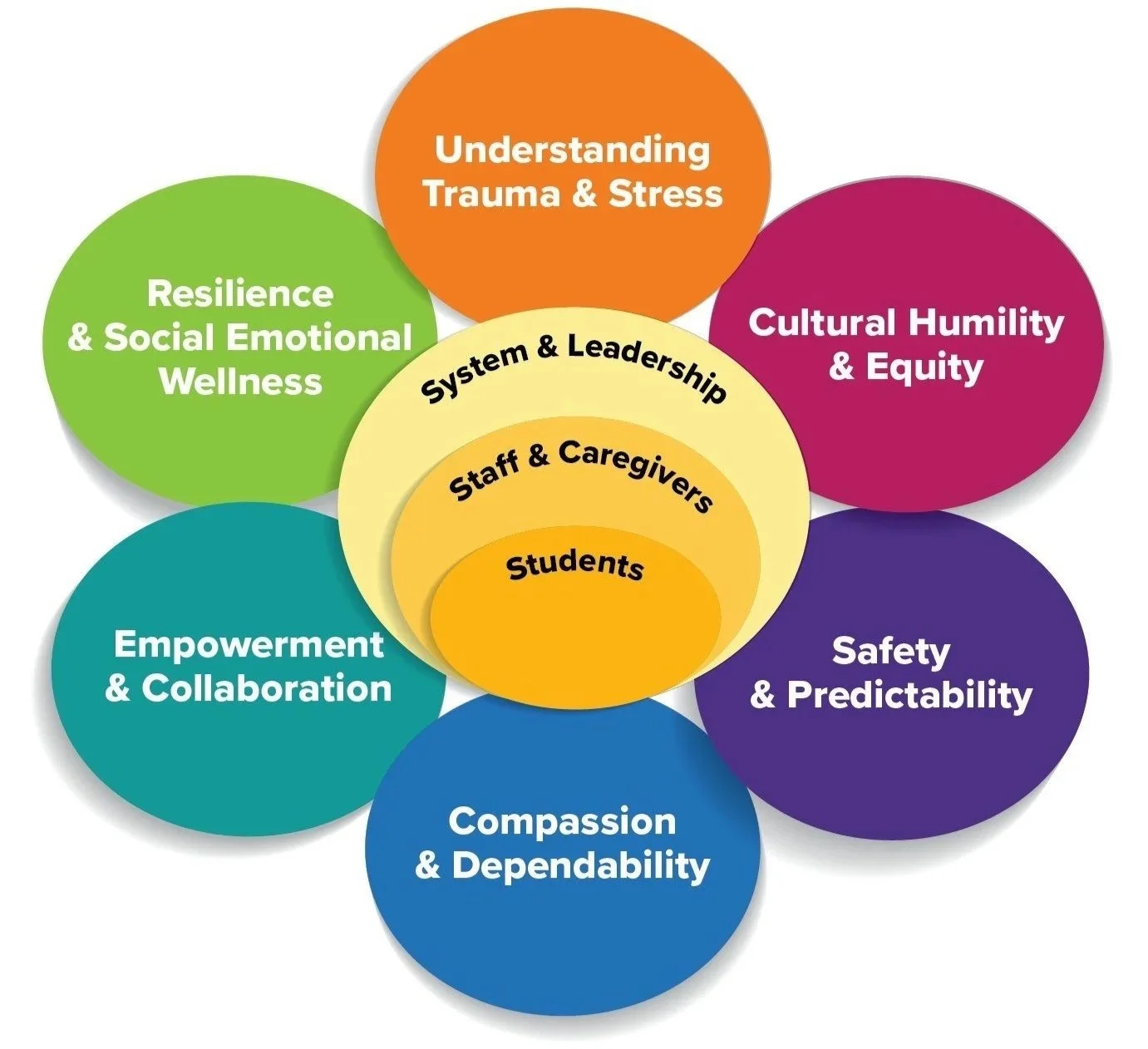
Understanding Trauma and Stress
The Issue Without understanding trauma, we are more likely to misinterpret trauma-related behaviors as willful, "sick," or "crazy," which can lead to ineffective, stigmatizing, and/or punitive reactions towards trauma-impacted people.
The Solution Understanding how trauma and stress can affect individual neurophysiology, relational interactions, and organizational functioning can help to reframe otherwise confusing, aggravating, or fear-producing behaviors. Shifting our perspective from "What is wrong with you?" to "What has happened to you?" can lead to more compassionate, strength-based, and effective responses to trauma-impacted people and communities that support healing and mitigate harm.
Learn MoreCultural Humility and Equity
The Issue Racism, sexism, homophobia, ableism, and other forms of societal oppression can be trauma-inducing and push communities of people out of schools, systems of care, and other organizations.
The Solution When we are open to reckoning with the trauma and adversity caused by historical and present-day structural oppressions and hold ourselves accountable to counteracting these forces as individuals and institutions, we can work together to mitigate these harms and to foster equity and belonging for all of us.
Learn MoreSafety and Predictability
The Issue Trauma unpredictably violates our physical, relational, and emotional safety, resulting in a heightened sense of threat and a need to manage risks.
The Solution Having our physical, relational, and emotional safety needs met and increasing predictability in our daily lives can minimize our stress reactions and allow us to focus our resources on healthy development and learning.
Learn MoreCompassion and Dependability
The Issue Trauma can leave us feeling isolated or betrayed, which may make it difficult to trust others and receive support.
The Solution When we experience relationships that are compassionate and dependable, we re-establish trusting connections with others that foster healing and well-being.
Learn MoreEmpowerment and Collaboration
The Issue Trauma involves a loss of power and control that can make us feel helpless.
The Solution When we have real opportunities to make choices for ourselves and have meaningful voice in decisions that affect us, we regain a sense of agency and feel empowered to advance well-being and justice for ourselves and others.
Learn MoreResilience and Social Emotional Wellness
The Issue Trauma can create feelings of hopelessness and derail the development of healthy social, emotional, and cognitive skills, which can then compound trauma's negative effects.
The Solution Honoring strengths, cultivating wellness practices, and building social-emotional learning skills that promote self-awareness, self-management, strong relationships, and civic engagement will boost resilience and enhance success in school, at work, and in our communities.
Learn MoreThe HEARTS Toolkit, including all materials contained in the toolkit, was created under a Creative Commons copyright license. This license lets others remix, adapt, and build upon the toolkit content non-commercially, as long as they credit HEARTS and license new creations under identical terms.
Please use the following citation to credit the HEARTS Toolkit: Dorado, J, Guinosso, S, Evans, N, Merchant M. (2023). Healthy Environments and Response to Trauma in Schools (HEARTS) Toolkit.

This work is licensed under a Creative Commons Attribution-NonCommercial-ShareAlike 4.0 International License.
