

Key Concept #1 Safety and predictability are fundamental to being able to engage our “thinking-learning brains.”
- Students need to feel safe in order to learn, and educators need to feel safe in order to teach.
- If the adults don’t feel safe, students won’t feel safe.
Key Concept #2 Safety entails: physical safety, relational safety, emotional safety, predictability.
- Physical safety: Welcoming and inviting physical environment that is free of physical harm and unnecessary triggers (e.g., loud sounds, slamming doors).
- Relational safety: Affirming and supportive interactions/relationships that convey unconditional caring and protection from harm in order to minimize dysregulated/triggered reactions and provide support in times of stress. Relational safety can be built with concerted effort and time.
- Emotional safety: Having the space and ability to express and regulate emotions and manage stress (e.g., mindful moments, breaks).
- Predictability: Stable and predictable school environment. Clear and positively stated expectations that are agreed upon, well-communicated, and equitably enforced; use of routines and rituals; explicit preparation for changes and transitions.
Key Concept #3 Many existing school-wide strategies (e.g., SEL, PBIS, Restorative Practices) help to create and maintain safety.
- In many ways, a trauma-informed lens is the “why” that motivates us to continue with many of the best practices we are already doing. In times of stress, these strategies and approaches may fall by the wayside. But a trauma-informed lens reminds us that the “what” of what we can do is at our fingertips if we can create time and space to do them.
Key Concept #4 All individuals experience a predictable escalation/de-escalation cycle in response to a trigger or extreme stressor; where one is on the cycle determines which strategies are most effective for maintaining or returning to a regulated, thinking/learning state.
- The escalation/de-escalation cycle starts in response to a trigger or stressor and is followed by a period of agitation, acceleration, escalation peak (and potential for re-escalation), then leading to de-escalation, a dip, and eventually recovery (see Figure 3.1).
- Understanding the escalation/de-escalation pattern can help us choose interventions that will most effectively maintain calm environments, prevent and reduce triggers, and return students/staff to a regulated, thinking/learning state when escalation occurs.
- It is possible to flatten the intensity of the escalation/de-escalation cycle with effective strategies applied at the appropriate phase in the cycle.
- Strategies that maintain calm and repair harm post-escalation help towards escalation prevention.
Figure 3.1 Escalation/De-Escalation Cycle
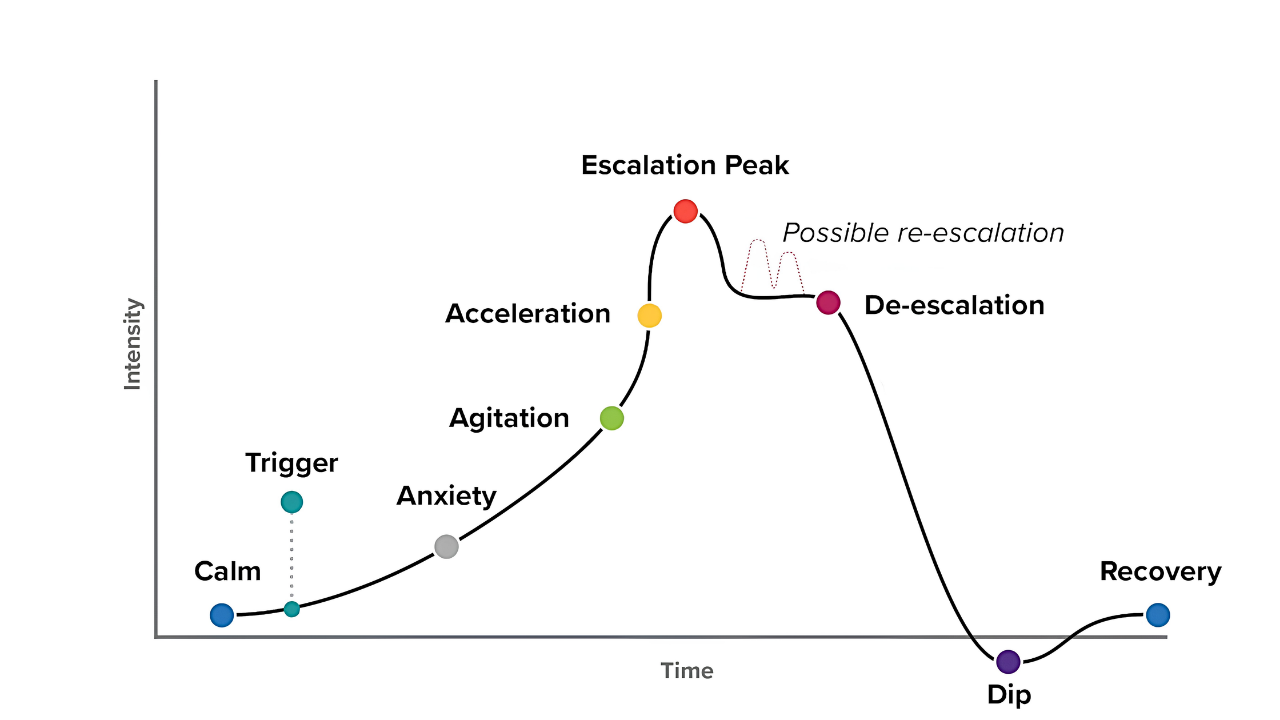
- The escalation/de-escalation cycle for an escalated individual and a responder are the same shape, but the responder’s cycle is delayed. Where the cycles cross is where re-escalation could occur because an escalated responder is vulnerable to reacting in a dysregulated manner that re-exacerbates the still-dysregulated state of the initially escalated individual. When we escalate one another, the ability to think clearly for both the escalated individual and the responder (cognition cycle) becomes extremely low (see Figure 3.2).
Figure 3.2 Delayed Responder’s Cycle Causes Risk for Re-Escalation

Key Concept #5 Our own values, attitudes, and strategies around addressing challenging behaviors are influenced by our own cultural background, upbringing, and social location.
- When we misinterpret the cause of challenging behavior through the lens of our unexamined cultural biases, this affects how we feel about the behavior, which then influences our response/reaction to the behavior.
- When our response is disproportionate to the behavior itself (e.g., overly punitive or permissive) this can cause unsafety.
- When there is disagreement among adults in a school around what causes challenging behavior and how it should be addressed, this causes relational unsafety.
Key Concept #6
The safety of white people should not be prioritized over that of people of color.