
Cultural Humility and Equity

“Cultural Humility is a process of communal reflection to analyze the root causes of suffering and create a broader, more inclusive view of the world.”
  • This is a lifelong process of reflecting together as a community to examine how societal oppressions are embedded into our institutions and show up in our individual interactions, and how these oppressions are the root cause of much suffering.
  • In addition to being aware of these oppressions, we must also hold ourselves accountable as institutions and individuals to counteract these harms.
  • Cultural Humility also involves recognizing and changing power imbalances, including establishing mutually beneficial relationships with community members that highlight community expertise.
Key Concepts
Key Concept #1 Societal oppression (e.g., racism, sexism, homophobia, xenophobia) is trauma-inducing.
  • Experiences traditionally considered to be traumatic (e.g., assault, abuse, sudden loss) happen in the context of societal oppression. Societal oppression evokes the same neurobiology as other forms of trauma, and we refer to this as sociocultural trauma. When people experience both traditionally-defined trauma and sociocultural trauma, there is a synergistically adverse effect (see Figure 2.1). Thus, addressing sociocultural trauma is crucial to any trauma-informed approach. For example, if a practice, procedure, or policy is not racially just, it is not trauma-informed.
  • Structural Racism is a system in which public policies, institutional practices, cultural representations, and other norms work in various, often reinforcing ways to perpetuate racial group inequity. It identifies dimensions of our history and culture that have allowed privileges associated with "whiteness" and disadvantages associated with "color" to endure and adapt over time. Structural racism is not something that a few people or institutions choose to practice. Instead, it has been a feature of the social, economic, and political systems in which we all exist (Aspen Institute).

Figure 2.1. Synergistic Effects of Trauma

Figure 2.1 Synergistic Effects of Trauma
Key Concept #2 Combating injustice is central to creating trauma-informed schools. Structural racism and the resulting sociocultural trauma are embedded in school systems and thus must be addressed in order to prevent schools from being a source of trauma.
  • Examples of how structural racism shows up in schools:
    • The racial achievement gap, which refers to the racial disparities in standardized testing, graduation rates, etc., is one example of the systemic impact of sociocultural trauma.
    • The "school to prison pipeline," in which punitive and exclusionary disciplinary measures have resulted in students of color and students with disabilities being disproportionately suspended and expelled from school and ending up in the juvenile justice and prison population, is another devastating example of sociocultural trauma's systemic impact.
    • Tia Martinez presentation "Mapping the School to Prison Pipeline" - 1.5 hrs
    • School-to-Prison Pipeline overview video - 1.5 minutes
    • A Tale of Two Cities video describing health inequity - 2 minutes
Key Concept #3 We all have multiple dimensions of identity, often with different levels of power/privilege associated with each identity characteristic (see Figure 2.2).
  • Race, gender, age, sexual orientation, citizenship, education, etc. all intersect within each of us as individuals and contribute to how we move about the world and are perceived and treated by others.
  • Being aware of intersectionality and how the various categories that we fall into are on the up-side and/or down-side of power in our society allows us to interact responsibly with one another in a way that promotes equity and creates a sense of belonging for each of us.

Figure 2.2. Wheel of Power and Privilege
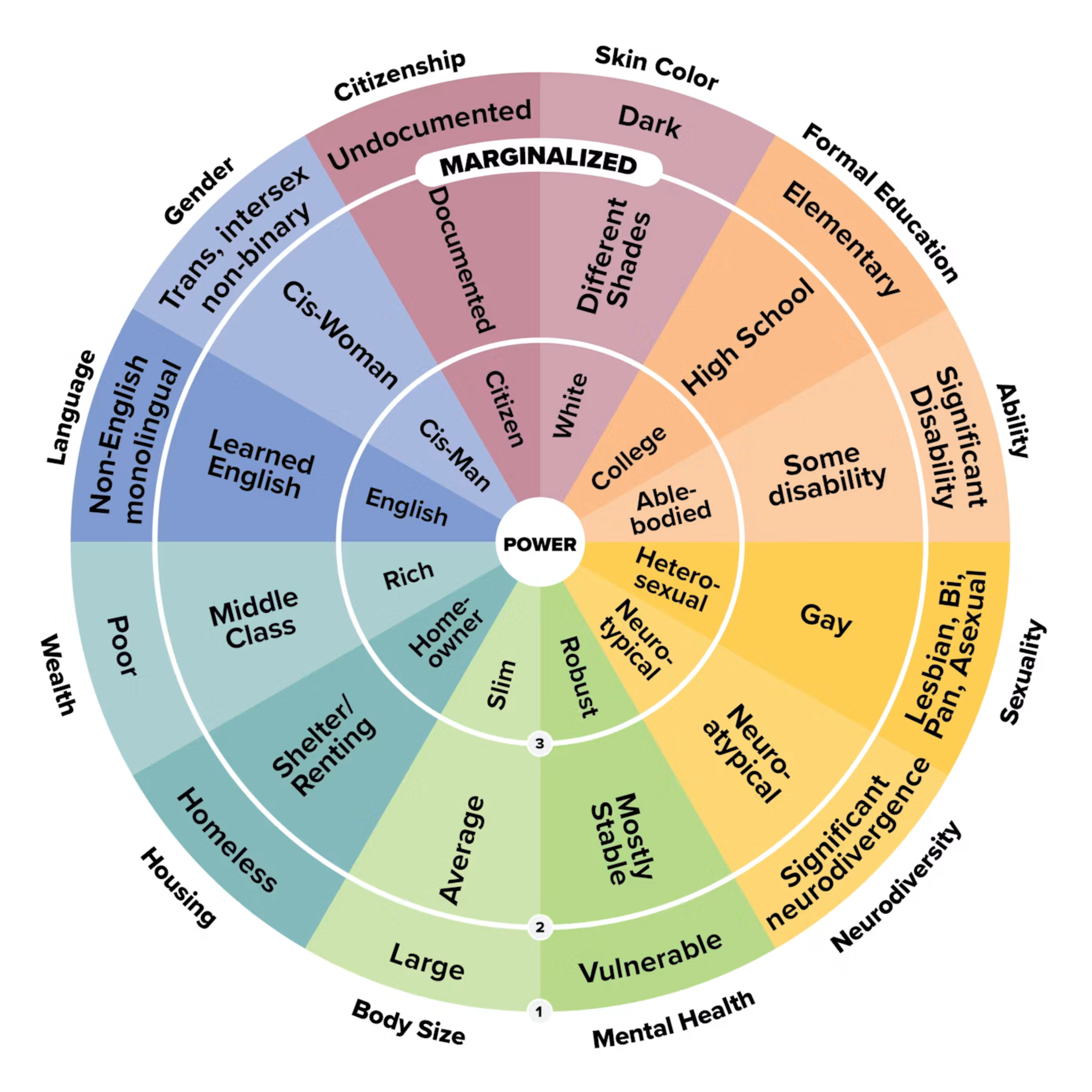
Figure 2.2 Wheel of Power and Privilege
Key Concept #4 Due to the "smog" of biases that we live in, we all have biases and are vulnerable to enacting them. It is our responsibility to be aware of our own biases and to prevent our biases from causing harm.
  • Even as early as preschool, Black children, especially Black boys are over-surveilled for the possibility of inappropriate behavior by teachers.
  • Black children are more likely to be seen as older and thus not viewed with the same "childhood innocence" as their white same-aged peers.
  • Conditions characterized by stress, auto-pilot, ambiguity, and lack of feedback exacerbate the enactment of implicit bias. Implementing strategies to mitigate these conditions can help to prevent sociocultural trauma.
  • Microaggressions are one way that our biases can cause harm. Microaggressions are defined as everyday verbal, nonverbal, and environmental slights, snubs, or insults, whether intentional or unintentional, which communicate hostile, derogatory, or negative messages to target persons based solely on their marginalized group membership.
Key Concept #5 We can mitigate the effects of bias to overcome sociocultural trauma.
  • Even though structural oppression is embedded into our interactions and institutions, there are effective practices, protocols, and procedures that we can put in place at both the individual and organizational levels to prevent or repair the harm that can result from biases.
Key Concept #6 Dismantling structural oppression and promoting inclusion and belonging is a lifelong journey (individually and systemically).
  • Combatting and dismantling systems of oppression is a process over time. We are bound to make mistakes and have setbacks from time to time, but creating meaningful change requires each of us to continuously do what we can, step by step, as individuals and as organizations.
  • We are working towards a sense of inclusion and belonging. Verna Myers, a leading expert in diversity and inclusion, says that, "Diversity is being invited to the party. Inclusion is being asked to dance." Taking it a step further, belonging is a feeling of, "I am welcomed here for who I am and what I bring. I belong because I contribute and I make a positive difference. I can be my authentic self."
Individual and Relational Staff Practices
Key Practice #1 Identify biases within ourselves.
Key Practice #2 Consider ways that our own power and privilege show up in our work at school (e.g., classroom interactions).
Key Practice #3 Address microaggressions and other forms of discrimination.
Key Practice #4 Build a sense of inclusion and belonging for students, families, and staff.
  • Utilize a variety of inclusive practices in the classroom.
  • Utilize culturally relevant materials, curricula, pedagogies, etc.
  • Practice the ABC's of Representation in Education:
    • Affirm Identity
      • I Am From Activity
      • Identity Map Activity
      • Ensure that pictures and decorations reflect and affirm the diversity of community throughout the school building, including in classrooms.
      • Post photos of present-day people who reflect the student community successfully making the world a better place.
      • Read books by and about people who look like your students.
      • Utilize places, people, and current day music/movies/games that your students recognize.
    • Build Community
      • Implement daily community circles and other restorative practices.
      • Share mealtimes with students, families, and staff.
      • Help students make connections across divides.
      • Plan for project-based learning in groups.
    • Cultivate Representative Leadership
      • Ensure leadership is representative of the school community.
      • Recognize and name leadership qualities in all students.
      • Create opportunities for students to practice leadership.
      • Identify leaders in the local community, and discuss them with students.
Key Practice #5 Engage in effective discussions around racism and other forms of oppression between adults and with students.
Key Practice #6 Expand knowledge and experience of race and culture (e.g. reading, listening, or watching content developed by and for creators who are BIPOC).
System-Level Policies, Routines, and Procedures
System #1 Assess the school's collective professional development needs around cultural humility and equity (including anti-racist practices), and offer ongoing professional development opportunities tailored to meet these needs.
System #2 Examine and regularly meet as school staff to review disaggregated school-wide and classroom data to understand how bias may be impacting students' school engagement and achievement.
  • Have a designated team that meets weekly to examine discipline data.
System #3 Routinely consider the ways that school staff's own power and privilege show up in their work at school (e.g., in classroom interactions, communicating with families and community members).
System #4 Invite perspectives of underrepresented or marginalized school community members into decision-making processes that will impact these members.
  • Embed a representative from each stakeholder group into the leadership team.
  • Hold regular forums where community members can voice and discuss concerns and ideas for school improvement.
System #5 Hire and retain staff who are from similar communities as students and/or who have a vested interest in the success of these communities. Prioritize their voices in school decision-making.
System #6 Embed culturally relevant and responsive curricula, practices and celebrations that reflect the full diversity of the school community (staff, students, caregivers) into the everyday school culture.
System #7 Reconsider policies and procedures rooted in white supremacy and anti-Black racism.
  • Dress codes
  • Truancy protocols
  • Routines and procedures that resemble those carried out in prison or policing (e.g., hands behind back or on top of head while walking in line, random backpack searches, etc.)
  • Pivoting Away from White Supremacy Culture at Work
Reflection Questions
1

How does personally-mediated and structural racism show up in your domain of work at your school (e.g., classroom, front office, school-wide policies)?

2

How does white supremacist culture (perfectionism, productivity > people, avoidance of healthy struggle) impact your team?

3

What might be some worries, concerns, or fears that some people may have about discussing structural racism in schools?

4

How might anti-racist, culturally affirming educational practices benefit students of color as well as white students?

Resources
“Your desire to be seen as good can actually prevent you from doing good, because if you do not see yourself as part of the problem, you cannot be part of the solution.”~ Layla Saad

Share this resource list!